This is what it’s all about. You gardeners out there will get it… the patience, planning and perseverance pay off.

In the bleak midwinter.

Spring is slow to do it’s thing.

Oh, hello summer! In all your loveliness, finally, you arrive.
This is what it’s all about. You gardeners out there will get it… the patience, planning and perseverance pay off.
In the bleak midwinter.
Spring is slow to do it’s thing.
Oh, hello summer! In all your loveliness, finally, you arrive.
It’s been a week since my RHS Chelsea Flower Show visit. I’ve been reflecting on this bonkers British gardening extravaganza and concluded that it’s probably more creative, and certainly more eccentrically British than most, nay all, of the other fixtures on the UK summer festival circuit, only the average age of the visitors is about 40 years older.
Overhearing the conversations going on with the garden designers around me, it’s clear that the intensity, stress and pressure in the run up to the show is not for the fainthearted… Nothing like press day as an immovable deadline. Up to 100-strong teams work on each of the 17 show gardens, costing up to £250,000 each to build (that’s a whopping £4.25 million, before we’ve even got to the construction and displays in the immense 3 acre floral marquee, the Artisan Gardens or Fresh Gardens). Then, once the doors are opened, the celebs, press and 165,000 hoi- polloi flood in. The spotlight shines on not just the intricacies of the gardens, but the designers (and to a lesser extent the exhibitors) themselves. A never ending stream of interviews, introductions and champers follow over the next week, mixed with the emotional highs and lows of whether your garden is deemed to strike gold in the controversial medal grading system.
Even if one had the skill, would one have the stamina or the courage? These Chelsea designers are a rare breed indeed.
What follows are a few highlights of a memorable day, with huge thanks to the incomparable Ann- Marie Powell, Charlotte Martin of Area Landscape Architects and Stephanie Hensley. Even more memorable had I managed to shown some restraint on the champagne that was flowing… but where’s the fun in that?

Ming Veevers Carter’s incredible floral art installation for New Covent Garden Market celebrating the Queen’s 90th. A worthy winner of Gold

The Young Chelsea Florist of the Year competitors designed fantastic Brazilian Carnival Headdresses. This creation by April Bennett wasn’t the winner! There is no justice in this world…

Grayson Perry considers upping the accessorising ante, Chelsea style.

Maths x gardens equals a silver guilt for Nick Bailey’s “The Winton Beauty of Mathematics” garden.

Detail from Ann- Marie Powell’s “Greening Grey Britain” for Health, Happiness and Horticulture.

What you lookin’ at? The view from inside Andy Sturgeon’s Best in Show Telegraph Garden.

Could they be discussing a future Chelsea collaboration? Grayson’s confirmed his interest in making a garden… Ann- Marie’s a partner who would equal his panache.

Andy being interviewed… again.

Detail from Andy Sturgeon’s “Captured Landscape”.

The jaw- droppingly colourful beauty of the Akzonobel Honeysuckle Blue(s) Garden designed by Stefan Jaspers featuring planting used traditionally to dye fabric. The backdrop is a hand felted installation by Claudy Jongstra. If I ever win the lottery, I think this wall hanging is #1 on my wishlist. (Along with the garden, too, of course).
After a hiatus for a few weeks whilst Spring gathered momentum and the garden finally raced away, I wanted to record progress and share some of my humble highlights. (Photos chosen by my eldest daughter as the ones that were “least boring”.) The Stream Garden was planted in August last year, so this is the first time I’ve actually seen the Spring blooms since I narrowed the plant choices down from internet photos and catalogues. The gaps are still many, but it’s getting better and better…

Geranium macrorrhizum “Spessart”. Bright green, semi – evergreen scented foliage, months of flowers, races ahead in early spring whilst other perennials are still struggling. So easy to propogate, it was the plant that gave me the gardening bug. Scraps of roots of this type of Geranium from my sister’s garden thrived after I sceptically shoved them in the soil… (p.s. not to be confused with the red window box Swiss chalet “geranium”, a totally different plant that isn’t a geranium at all but is actually called a pelargonium….)

Japanese Primroses (Primula japonica) from Beth Chatto’s nursery – “Miller’s Crimson” and “Postford White”. Damp loving bog plants that were bought for the pond edges, but never got there. Mostly because I wanted to see them every time I looked out the window, but also because I feared the rabbits would destroy them in seconds.

Astrantia major (no idea which type – all my choices were deep reds so this dusky pink beauty must have been mislabeled in its early life), Stipa tenuissima and Papaver oriental “Patty’s Plum”.

Bleeding Hearts and my fave Geraniums… again.

From L to R: the airy pink flowers of evergreen ground cover London Pride (Saxifraga x urbium) in the left back; a black Elderflower called Sambucus nigra “Eva”: will soon have dusky pink flat flower heads and eventually tower above the border, but not yet. Oriental Poppies ” Patty’s Plum” in the centre. Just underneath that, the bright yellow foliage of Aralia cordata “Sun King”, a VERY late starter that is tormented by slugs. Not sure I’d bother with it again. Aquilegia comes next: an unknown variety with two totally different types of bonnet – like flowers on the same plant- purple ruffle with a white rim on one stalk and pink, simple doves on another. (I’ve never seen that before). The grass spikes under the Aquilegia are feather reed grass or Calamagrostis x acutiflora “Karl Foerster”: small and green right now that will be 6ft tall golden and upright by September and all through the winter. Far right is the fine, green foliage of Sanguisorba “Red Thunder”, a damp and shade loving perennial that will have masses of tiny, burgundy bottle brush flowers on tall, wiry stems come autumn. They float about the plant, catch in the breeze and should shine with the golden feather reed grass background.

Seeing the emerging, vivid green woodland canopy with a carpet of bluebells beneath is a spring highlight that, for me, brings hope each year that nature will ultimately always triumph over the foolish ape that wants to dominate her at all costs.
As flower with its greatest worldwide densities in the ancient woodlands of the UK, Hyacinthoides non-scripta is so embedded in our national psyche that the National Trust has created a page highlighting the best Bluebell sites up and down the land.
I’ve been told of a couple of local bluebells woods, with long, convoluted directions of which country lanes to park on, where to start walking and for how long. A map with “X” marking the spot would be so much easier, and somehow more appropriate for this natural treasure.
For the record:
This week I have mostly been digging up and replanting blind daffodils in my woodland (the rabbits have eaten the 200 or so bluebell bulbs that my neighbour planted some years back); and sowing a wild flower seed packet border in the empty drive bed that’s awaiting funds for the planned plants. I’ve also made a start on the bog garden planting with some siberian iris and ostrich fern. So far untouched by the pesky rabbits. Next phase of planting here will hopefully be some Japanese Primroses. I may plant one sacrificial test primrose to see if it disappears overnight… and if it doesn’t, whether it will tolerate my slightly alkaline soil.
Some delights and some horrors from the garden to share this week: brace yourselves!
I’ve spent a good few satisfying hours peeling away mats of self-seeded grasses, primroses and forget-me-nots to reveal forgotten paths in the garden next door. This ready made turf has been relaid in the woods, where I hope the blankets can cover the bare soil and the primroses can get settled.
Whilst digging some very weedy borders, I came across this scary looking critter, about 5 cms long, curled up beneath the soil. It’s fascinatingly horrid, with its translucent bulbous tail and orange spots. (Those of a squeamish disposition, look away now!):

I undertook extensive research to find out what it is (a.k.a. emailing my Mum) who identified it as a chafer grub larvae. This critter will munch through the roots of your beloved, cherished (no doubt rarest) garden plants and leave them for dead. My instincts were right to leave it in the open to be devoured by the nearest predator. Foxes, badgers and magpies gobble them up like particularly gross jelly babies. Yum.
So that’s the beast over with, now for beauty: Euphorbia wulfenii and bluebells growing on a sunny bank a couple of days ago.

Followed swiftly by Lunaria annua, or Honesty: that of the moon shaped, mother of pearl seed pods which I recall from my childhood Christmas decorations:

Purple Honesty flowers are everywhere right now, so moments later, as I slogged uphill with buggy and child, a purple, blue and lime-green April combination pinged into my mind: forget-me-nots, bluebells, Honesty, Aubrieta and Euphorbia, maybe with a dash of Vinca of on the side : it would look dazzling, I think. The purple honesty and Aubrieta glowing against all the fresh spring greens and harmonising with the blues of tiny forget- me-nots and nodding clusters of bells…. talking of which:

I spotted these Snakes Head Fritillaries in a damp meadow this week. Would be rude not to share.
In the water meadow next door, fluffy bullrushes from last year are shedding their seeds by the thousand. They look wonderfully statuesque. Any large pond would be enhanced by their presence. Perhaps intermingled with some graceful, airy, damp loving Deschampsia schottland (mental note for pond).

A strange site that I didn’t think I was ever going to see – the pink clenched fists, fingers unfurling, of the Peony buds, finally making their appearance. Never mind that other Peonies nearby are in full leaf with large, marble sized flower buds, mine did survive the replanting! Hurrah!

Another quick beast to share, but don’t worry – very tame compared to the last one: Dandelions. The leaves shred in your hand leaving all roots intact. No wonder. THIS is what I pulled from a patch of gravel yesterday:

Until next week. Happy gardening.
Garden design books are ubiquitous. Every month sees the publication of a couple more titles. Some books have inspirational photography but text that is impenetrable (lists of Latin plant names don’t impress me much). Others are more for the coffee table with amazing, misty shots but no explanatory detail of any kind. A book of planting plans is great if you happen to have a plot just the shape and climate of that in the book, but who does? Not much good for covering the tenants of good design.
A couple of books break the mould, however. The Essential Garden Book by Terence Conran and Dan Pearson is one. The other stand-out title that I’ve referred to frequently is a beautifully produced publication by Heidi Howcroft (a landscape architect and author) and Marianne Majerus , an award winning garden photographer.

The book is filled with hundred’s of Majerus’ stunning images, accompanied by detailed explanatory text by Howcroft. It’s divided into sections, the main six of which are: Basics; A Question of Style; The Components; Greenery and Flowers; Furnishing; Difficult Plots and Tricks of the Trade.
“Basics” covers the initial research that must take place before a garden design can be conceived. “Style” looks at small, large, city, country, classical, modern, etc. with case studies galore and detailed images and captions. “The Components” offers guidance on structure (i.e. paths/ decking/ hard surfaces); steps and ramps; enclosures; and shaping the garden (undulations anyone? terrace perhaps? Or would you prefer a mound?).

Then comes “Greenery and Flowers”. This chapter, for me, is totally fascinating. It has the kind of attention to detail that I’ve never seen before in a gardening book. The photography is outstanding throughout, showing gardens that are real spaces (well, real spaces of the rich, I suppose), not the unachievable dream of a show garden. Case studies look in detail at the planting used to achieve particular styles. It even covers veggie gardens. No excuses for boring allotments after this. (Not that any allotmenteers I know would give a stuff about the aesthetics of their plot.)
Furnishing the Garden looks at water features, and interestingly, garden rooms. Lighting and Art are also covered. Finally, “Difficult Plots and Tricks of the Trade” covers roof gardens, container gardens and coastal and basement gardens, amongst others.
Any OCG would be inspired by the breadth of this book’s contents and the crisp, detailed photography. Definitely worth a few of your hard earned pounds.
Amazon link here: Garden Design, A Book of Ideas by Howcroft and Majerus. Published by Mitchell Beazley
I visited a garden this week that’s evolved over the last 40 years. It’s a proper country plot, surrounding an old farmhouse and sitting isolated in the flat Norfolk fields. What struck me was not only the encyclopaedic selection of plants, but also the number of statues and ornaments nestling amongst emergent leaves. I will return to capture more for the blog, but for now, here are some pictures that caught my eye in the early April sunshine at the weekend. As I look through them, I’m struck by the incredible intricacies and diversity of the plant life in a tiny space. Us Earthlings are lucky creatures.
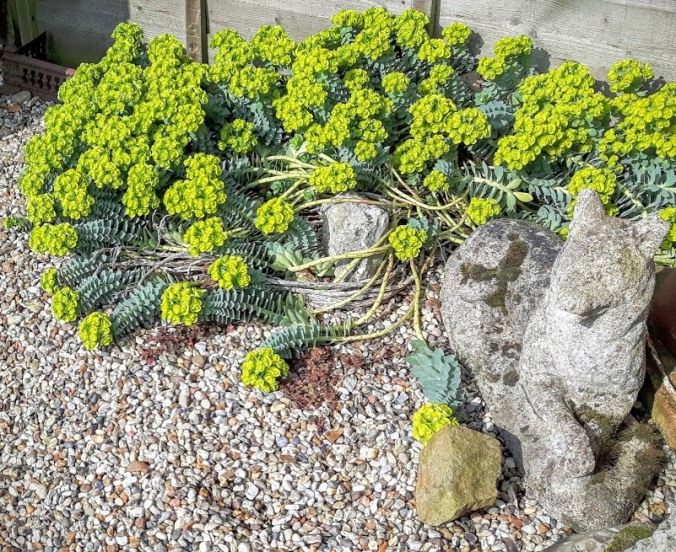
A guard dog by the entrance sits amongst the symmetrical, evergreen whorls and acid green flowers of Euphorbia myrsinites which thrives in this hot, dry spot.
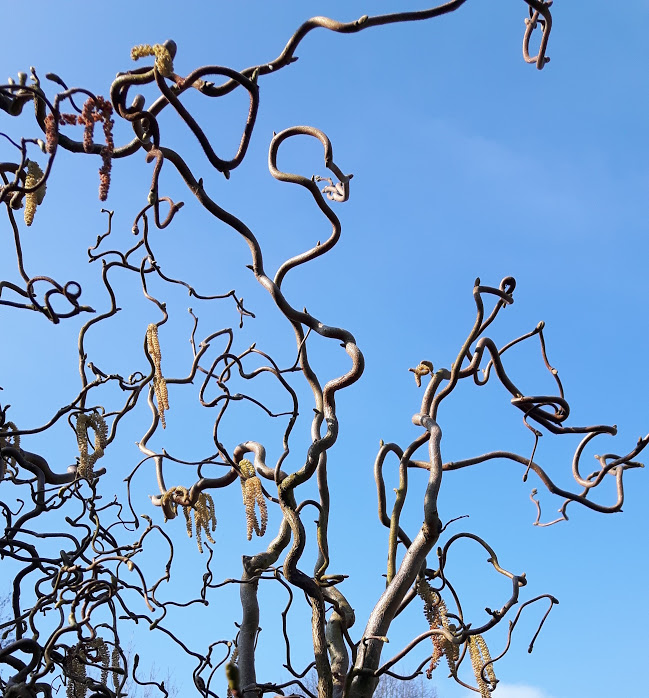
The Corkscrew Hazel (Corylus avellana “Corntorta”) at its best against the spring sky.
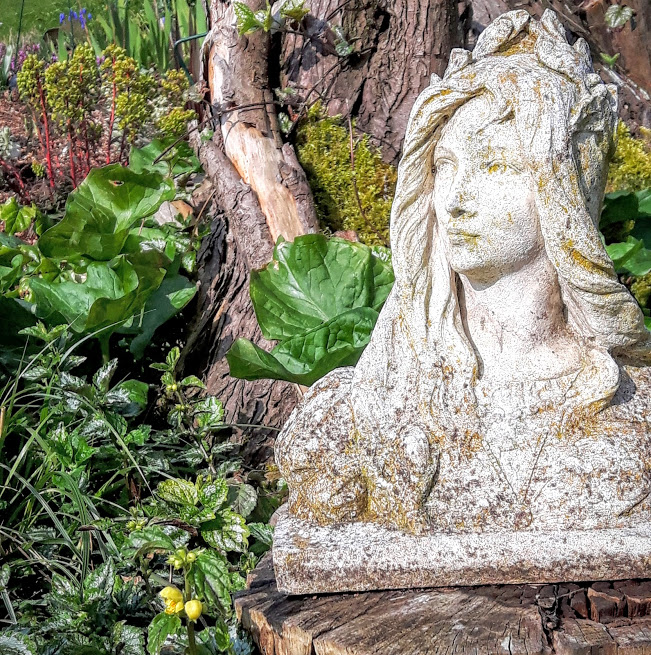
Who wouldn’t want this beauty gracing their flowerbed? The Yellow Archangel (Lamium galeobdolon) is a fitting parter, along with the red stemmed Euphorbia “Ruby Glow” in the background. I’m at a loss as to what the large upturned leaves in the middle ground are…?
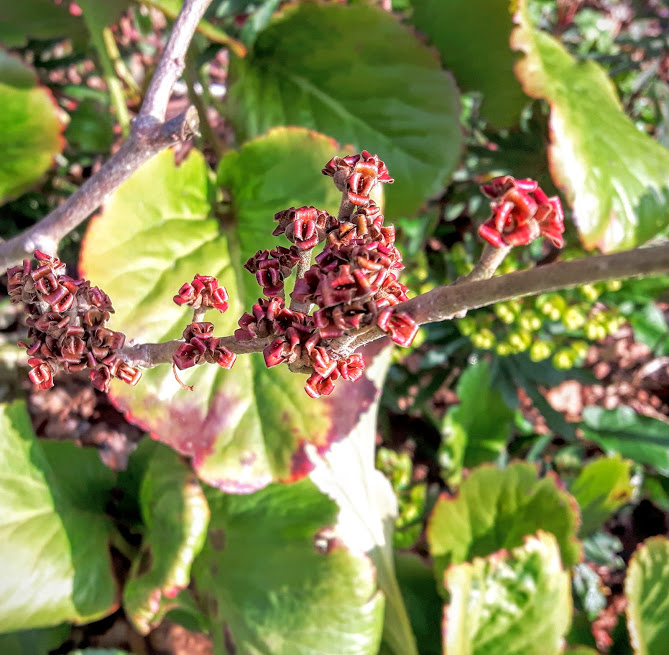
The fascinating, curled remains of the spiky, scented witch hazel (Hamamelis) flowers – I think I prefer these to the bright winter spikes. Alas, my soil is too alkaline. [Scrubs from bucket list].
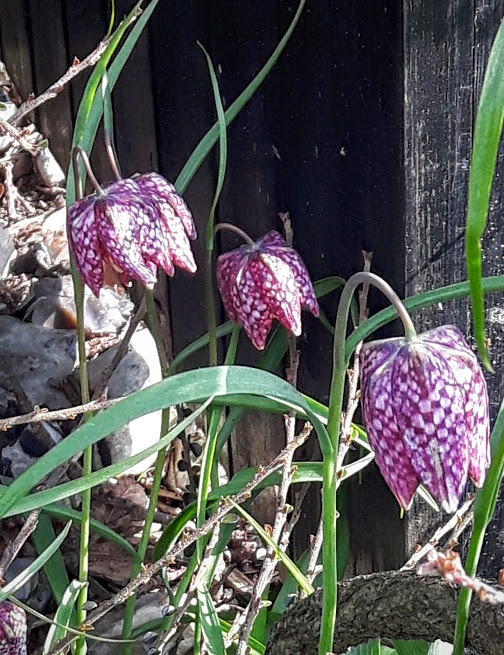
The unmistakable checker-board flowers of the Snakes Head Fritillary (Fritillaria meleagris). A must for damp, shady spots… with some patience (and luck), you will be rewarded by these beauties multiplying each spring.
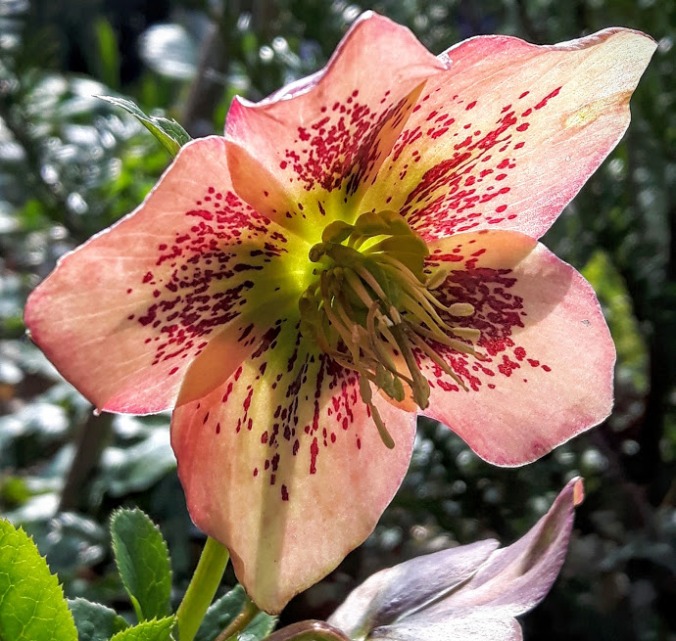
It’s no secret that I adore Hellebores. Impossible not to be uplifted by this freckled face.
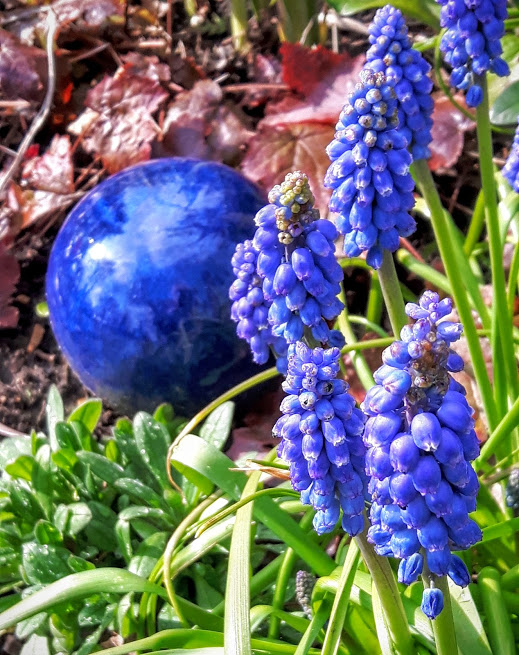
A perfect pairing of grape hyacinths and a shiny blue sphere with red Heuchera adding background zing.
(For my records, I’ve also seeded the woodland with grass seed, planted a herb garden in some old galvanised pots, re-potted an ancient money plant, searched for (AND FOUND!) Peony buds, replanted primroses and moved the sorry looking foxgloves to the woods this week. Whilst looking after the children in the Easter Holidays. Needless to say, the house is a disgrace. Luckily, if I’m in the garden, I can’t see it….)

Sloe blossom. Good to recognise if you like home brewed sloe gin.
Despite Hurricane Katie, Easter socializing and much over-eating of chocolate, I’ve managed to get in some garden time over the long weekend.
Weeding is therapy (for me at least). In the Stream Garden, I am uplifted to see practically everything now is either well on its way or showing tiny leaves and shoots. The replanted Peony has still done nothing, alas. I remind myself to be patient… (an Angelica archangelica I had given up for dead in the summer has emerged, fresh and shining this week). My daffodils are way behind the Jones’, but that’s probably because I planted them so late in Autumn. Fat flower buds are just starting to burst open. I’m always thinking of improvements for next spring, of course: more palest yellow daffs and primroses, planted in abundance under more dusty pink and slate Hellebores.
Planning ahead, I’ve planted some seeds. My record with seeds is poor. I think I shower them with too much love in the form of water. I was quite discouraged. Then two things happened: the Cosmos planted in- situ last year flowered so brilliantly for months; and an OCG friend recommended a website called Seedaholic . The site has a huge selection, all described in detail with lengthy growing instructions. I idly browsed and ended up with a digital basket full, the first of which to be sowed are Aquilegia atrata. Deepest purple – red doves with golden tails float over curling whorls of foliage. I have my fingers crossed for at least a few successes from the 25 planted. Secondly, I have a tray of Nicotiania alata “Lime Green” which are fiddly to germinate, but worth a try (I have 4,500 seeds to get it right!). The fragrant, simple, lime summer flowers will be a foil and filler of gaps in the burgundy planting of the Stream Garden. Consequently, the sunny window ledges are filled with slightly precarious seed trays.

http://www.seedaholic.com. Worth a look.
On a rather larger scale, I’ve planted some Gunnera manicata next to the pond. A “cutting”. Ha! Sawing more like.

Baby Gunnera. Eeek.
This looks like the T-Rex of the plant world. Spiky, thick, stems. Furled, leathery leaves. Dangling, pendulous roots. Huge umbrella leaves. The pond will look better for it once it’s settled in… I think. As long as it doesn’t get too comfortable. I’d be interested to know if anyone else has grown this monster and thoughts on controlling its spread. I don’t have enough space to be able to leave it unmanaged, but if managing it needs a chainsaw, I’d rather know now!
Feeling lucky to have acquired a rather sorry looking Mountain Ash or Rowan (Sorbus aucuparia ) from a generous friend who offered it to me as I eyed up the neglected tree potted next to her front door. The roots don’t look great at all, but it has buds so I planted it nevertheless in the newly dug and empty Drive Beds. (It will be an anchor to the fledgling winter bed forming in my mind. I’m thinking the new Rowan, Dogwoods, a Crab Apple, Persicarias and a yet to be chosen evergreen grasses).
I used this helpful video on tree planting by the RHS as a guide as it’s not something I’ve done before. Hopefully, the Rowan will grow strong again. A resurgence that will be fitting for it’s Easter earth date.
After the warmest winter on record, spring seems to be dragging its heels and teasing me. Looking back over previous years pictures to find blog inspiration, I soon realised that, in my garden at least, nothing much has woken fully yet. A few haven’t stirred at all. (I replanted a Peony in autumn and every day, I peer at the spot, searching for pink buds unfurling. But nothing.) Still lots of bare soil. Which I hate. It got me thinking about evergreen ground cover that looks its best during the winter/ early spring. The leading ladies of the cooler months, if you like…

Euphorbia amygdaloides var. robbiae, and Vinca minor: dry shade ground cover that looks amazing right now.

Sempervivums: how I love thee, let me count the ways. Planted in the sunny gravel that’s covering the french drain in the front garden. Looks just as good in January as it does in June.

Not strictly ground cover, but still looking good in February. Carex comans “Frosted Curls” and Pittosporum tenuifolium “Tom Thumb”. A combination from RHS Hyde Hall that would work work well even on a smaller scale. Even better, in my humble opinion, if the Pittosporum had been clipped into spheres.

Fine blonde Stipa (or Nassella) tenuissima makes a fine contrast to the burdundy-leaved Bergenia purpurascens “Irish Crimson”. This is Beth Chatto’s hot, dry gravel garden in January. I just about resisted the urge to tidy the dead leaves.
After my bargain Box buy last week, I’ve been potting on the plants and thinking about what to do with my new babies. It’s hard to find a single gorgeous garden that doesn’t feature Buxus sempervirens in one form or another. Clipped Box contrasts so beautifully with soft flower beds. It provides focal points and evergreen structure to a garden. It’s uses are many: edging, hedging, topiary, balls, cubes, pyramids, spirals…


Before I get too carried away, Box blight is an alarming, incurable problem, turning plants from lush green to dead brown in a matter of days. If Monty Don has a problem with it, us mere mortals have no hope. There are steps to take to mitigate the risk, all concerned with reducing damp, dense plants on which the two Box blight viruses thrive: only prune when there’s a dry week ahead; water from below not above, shape into curves not flat surfaces. The ultimate precaution would be to grow other small leaved, clip-able bushes (see RHS suggestions for box alternatives.) However, at 16p a pop, I haven’t got much at stake. I’m prepared to gamble my pennies.
My initial idea is to create a lovely little box hedge around the symmetrical Stream Garden beds. The design of the Stream Garden was influenced by Marylyn Abbott’s jaw – droppingly lovely Topiarist Artisan garden at the Chelsea Flower Show in 2014, pictured (x2) below, so the addition of the box hedge would be an obvious evolution.

The Topiarist Garden at West Green House, by Marylyn Abbott. Chelsea, 2014. Box paired with white foxgloves, alliums, lupins and climbing hydrangea.
I investigated mini hedges, and here’s what I learned: keep pinching out the growing tips to keep them bushy; don’t clip them for as long of possible; plant out when they have reached 10 x 10 cm bushlets. Use a plumb line to plant them straight and plant at approx 30 cm intervals…. so that would mean I need a whopping 90 plants to border all the beds. That’s only about £30 worth at Lidl prices, so I’m very tempted. All I need is a little patience. In a couple of years, I could have a neat and lovely cottage garden hedge.
Am I tempting blight with flat hedge tops? Perhaps. With even more patience, I could grow some rather wonderful spirals for a focal pièce de résistance. Is there another word for 10 years worth of patience? Endurance? These spirals are created by making a chicken wire mould, clipping the main shape, then draping a rope over the plant to guide the line, taking a deep breath, shears in hand, Dutch courage optional.

The Topiarist Garden again, from Chelsea 2014
Perhaps I’d prefer my box as a ball? It’ll take a couple of years to…erm… grow some big balls. Here are the step – by – step instructions on how to do it from BBC Gardeners’ World.

The Telegraph’s show garden from ’14, featuring domes of box, larkspur, Stipa gigantea, Nigella, Euphorbia and Iris “Jane Phillips”
Cleve West’s Contemporary Paradise Garden, also from Chelsea 2014:

Simply add Box balls, an intricate stone fountain, and (from bottom middle, clockwise) purple Nepeta, white Astrantia, indigo Centaurea, buff spikes of Heuchera “Thomas”, white Centranthus ruber, and lilac Verbascum phoeniceum and voila.
All in all, lots of options for the Box. I will post pics of my creations as and when my plan[t]s come to fruition…or blight . One or the other.

